
Showing posts with label LITERATURE. Show all posts
Showing posts with label LITERATURE. Show all posts
Saturday, 15 March 2014

Sunday, 2 March 2014
Charles Dickens (intermediate)
Learn about Charles Dickens' life and work. Enter this site (just click on the image) and watch the animated video. You'll also find a game about Victorian England.

Enjoy!
Thursday, 17 October 2013
OSCAR WILDE'S BIRTH: 16th October, 1854
Oscar Wilde was an Irish writer whose biography is a tribute to life: no boundaries could possibly put a limit to his thought or his actions. Only prejudice could, and it destroyed him.
His delicacy and his wit make his readers admire the man as well as the writer, because life and art were one in him.
You can read most of his work in this link:

Watch this video of one of his tales for children narrated by Stephen Fry, a famous English actor and writer who played the leading role in Wilde, a 1997 biographical film based on Oscar Wilde's life.
Learn about Oscar Wilde's times: Victorian England.
Read some of his quotes:

AUDIOBOOK: Listen to The Importance of Being Earnest.
I bet you won't be able to stop laughing with the following delicious scene of this masterpiece!
(You can activate the English subtitles by clicking on Choose Language (bottom left) and then English 100%).
You can download this worksheet to read some of the most hilarious moments of The Importance of Being Earnest. You can also do some additional work to learn more about this book and its author.

Click on the arrow to download it.
(You need an account in http://www.4shared.com/. Sign up, it's free).

This is a preview of the film on Wilde's life:
Read some of Wilde's words about life, love, people and other topics.
If you want to read an excellent biography on Oscar Wilde, I strongly recommend this one:
ELLMANN, Richard. Oscar Wilde. London: Penguin Books, 1987.
Here are my impressions after reading it:
We can but highly recommend a
magnificent biography of Oscar Wilde by the author of other excellent
biographies, such as Joyce’s: Oscar Wilde,
by Richard Ellmann. Ellmann offers us his profound knowledge of Wilde with the
utmost credibility, unaffected by his obvious devotion towards the writer and
the person. The riches and precision of the vocabulary that he employs and the
vast array of facts about Wilde’s work and life give the reader a sensation of
following Wilde and even being an observer of his contradictions, delights,
afflictions, and, what’s more important, of his development as a human being.
Ellmann starts every chapter
with a quotation of Wilde’s words and after that provides us with a thorough
display of details of his writings, life, relations, joys, and misfortunes.
Under this light we confirm what we could glimpse when reading every one of his
books, that Wilde was pure excess, just like life, and he could not be stopped
by morals, even though these could (and did) crush him. “Though he offered
himself as an apostle of pleasure, his created work contains much pain” (p.
xiv).
 He was the best company, witty
and an unequalled conversationalist, always generous with his guests and acquaintances,
lovers or even strangers. He didn’t receive the same token when he was accused
of immorality and sent to prison. Most of his friends abandoned him and refused
to help, and the few years he lived after being in jail he was ruined. He died
in exile accompanied only by a couple of friends, Reggie Turner and especially
Robert Ross, who never left him. His personality and his intelligence were not
fit for the times, which were but rigid and hypocritical, and nothing was more
alien to Wilde, whose passion for life was endless and could not possibly be
hidden.
He was the best company, witty
and an unequalled conversationalist, always generous with his guests and acquaintances,
lovers or even strangers. He didn’t receive the same token when he was accused
of immorality and sent to prison. Most of his friends abandoned him and refused
to help, and the few years he lived after being in jail he was ruined. He died
in exile accompanied only by a couple of friends, Reggie Turner and especially
Robert Ross, who never left him. His personality and his intelligence were not
fit for the times, which were but rigid and hypocritical, and nothing was more
alien to Wilde, whose passion for life was endless and could not possibly be
hidden.
Life or art, what comes first?
Both were irresistible for Wilde, but there can be no doubt when knowing him in
such depth as Ellmann does: Life is generosity and splendor, but it comes
second, as it can only imitate art, and only the latter can come near
perfection and is a mirror to life. Art is the true creator, and only creators
can shape life. This explains why Wilde was so careful with every detail, every
word he chose, every garment he wore, his hair, his surroundings, his home and
its decoration, etc. Everything had to be perfect, a work of art, for life
deserves no less. Morality is only a constraint and limits the creator. Only
intelligence and taste can prevail. That’s why he never confined himself to one
specific faith or group (he played with the idea of becoming a Christian and
joined masonry at the same time!). Why not taste them all? He had to be sent to
prison by the society that he had exposed to put limits to his passion for
life, and that killed him. We can imagine the suffering of such sensibility
imprisoned. No blue china, no champagne, no books, no words, no air. A man of
his delicacy could not survive the lack of beauty and the fetid air of jail.
His purity was suicidal.
“Essentially Wilde was
conducting, in the most civilized way, an anatomy of his society, and a radical
reconsideration of its ethics. He knew all the secrets and could expose all the
pretense. Along with Blake and Nietzsche, he was proposing that good and evil
are not what they seem, that moral tabs cannot cope with the complexity of
behavior. His greatness as a writer is partly the result of the enlargement of
sympathy which he demanded for society’s victims” (p. xiv). “We inherit his struggle
to achieve supreme fictions in art, to associate art with social change, to
bring together individual and social impulse, to save what is eccentric and
singular from being sanitized and standardized, to replace a morality of
severity by one of sympathy” (p. 553).
Wilde, we dare add, couldn’t
possibly have had a more appropriate name and definitely honoured it, as
Ellmann’s biography depicts with such precision and elegance.
To: Oscar Fingal O'Flahertie Wills Wilde,
Wednesday, 3 July 2013
K
Do you know anyone who can be recognized by a single letter? There are not many people like that, are there?
We know friends and relatives by their names or their nicknames; for most acquaintances we even need a surname. But if you say K, millions of readers around the world will know who you are talking about, Franz Kafka, the writer who was born on this day one hundred and thirty years ago.
This special writer's words leave no one indifferent. His words are enigmatic, as he was himself, yet we can understand if we read carefully, we can recognize his struggle with his main enemy: himself.
This short story, a parable called Before the Law, belongs to one of his books, The Trial, a disturbing novel that starts this way: one morning two guards knock on K's door and arrest him. K is not given a reason, doesn't know what he has done, where he is going to be taken, who is going to judge him.
The following scenes belong to Orson Welles' 1962 film, The Trial, which begins with this parable read by himself.
(You can activate the English subtitles by clicking on Choose Language (bottom left) and then English 100%).
Monday, 1 July 2013
Kafka
Do you know the term "Kafkaesque"?
It applies to strange, surreal situations such as those that Franz Kafka, the writer who gave origin to the word, described in his novels and short stories, often apparently absurd and incredible.
 Kafka, one of the greatest and most influential writers, was born on July 3rd, 1883. He only lived for forty-one years and couldn't see most of his works published, but his writings have had an extraordinary impact on 20th century writers.
He was born in Prague and was the oldest child of a middle-class family, the only male, as his two brothers died at an early age.
He wrote in German, the language he normally used. His dream was moving to Berlin, but he was only able to do it at the end of his life.
We can read his writings thanks to his friend Max Brod, who protected and preserved them even through the Nazi regime which killed many of Franz's relatives and friends. Brod made most of them public years after Kafka's death in 1924, even though Kafka had asked him to destroy them (perhaps not credibly enough). Some of his work and documents are still unpublished, in private hands, awaiting a legal decision over their ownership.
Kafka's work is extremely personal, an expression of his inner fight through life, an ordeal from which he could only escape through writing. I am literature, he wrote. He loved life deeply but often found pressure unbearable, especially that pressure which forces one to follow certain trodden paths that he could only question, not accept.
Marriage and family life, for example, were an obligation for him as a Jew, but not made for Kafka. He attempted to abide, though, and had a fiancée for years, Felice Bauer. He wrote dozens of letters to her, who lived in Berlin, and was about to marry her twice, but in the end he was unable to conform.
His father was a very important figure in his life, the "perfect" example and reminder of what he "should" be, solid and hardworking, a provider to a close-knit family, but their relationship was not an easy one, as Kafka often felt crushed by the overwhelming figure of his father. Later he would express his feelings in a long letter published under the title A Letter to His Father.
 We could say he was almost relieved when, in 1917, the doctors gave him the terrible diagnosis: tuberculosis. This seemed to make him feel liberated from some obligations. He then broke off with Felice and could finally spend most of his time writing. Later on he moved to Berlin.
Throughout his life, Kafka wrote many letters to his friends, lovers, relatives and publishers; he wrote novels and short stories, and we can even read his personal diaries, the thoughts of one of those men who make us aware of unknown realities that only a few can sense.
"A cage went in search of a bird"
(The Blue Octavo Notebooks)
"A cage went in search of a bird"
(The Blue Octavo Notebooks)
Watch this video for more information on Kafka's life and work:
See some images of Kafka, Prague and the women he loved.
[Song: Where is the Village, sung in Yiddish and English by the Barry Sisters]
And a free adaptation of one of his best-known works:
The Metamorphosis.
Oppressive institutions which annul the individual are a main concern of Kafka's. The Metamorphosis deals with one them, the family.
Saturday, 8 June 2013
1984. George Orwell (advanced)
The 8th of June marks the date of publication of 1984, by George Orwell, the pen name of an English novelist and journalist whose real name was Eric Arthur Blair. He was opposed to all forms of totalitarianism and injustice and wrote articles and fiction around them.
 Some terms that he coined have entered the English language and originated concepts that hadn't been considered before, but became realities in later years: cold war and Big Brother are just two of them. His novel depicts a crude world in which privacy is absolutely forbidden. People's emotions, work, time, passions, thoughts even, are owed to Big Brother, a political idol who no one knows and may not even exist. However, he is omnipresent, watching everyone anywhere all the time. BIG BROTHER IS WATCHING YOU can be read on walls and posters in all public places in Oceania, and so it is, as every second of each person's life is under surveillance by thousands of telescreens, even in their own private homes.
There's a Party, the elite, who make sure every citizen obeys the rules and lives exclusively for Big Brother, the leader who 'protects' each one of them and makes sure all enemies are destroyed, so that 'no threat affects the people of Oceania'. As long as there is an enemy, the Party is safe. But they, too, have a terrible foe, the one they fight against with all their power: Intelligence. Individual thinking is the beast.
The language is adapted to these principles, and Oceania has their own language with selected terms that shape everyone's mind. History is altered, too, to fit the needs of the Party. The Party is always right and no one has a right to object to it or even question it.
Is this world possible? Or was it only in Orwell's imagination?
Is this world possible? Or was it only in Orwell's imagination?
Orwell invites his readers to think (no more and no less) of the worst possible scenario.
Do you know what is in Room 101? Take a look...
(Click on Choose Language (bottom left) and then English 100% to read the subtitles).
(Click on Choose Language (bottom left) and then English 100% to read the subtitles).
It is the most dreadful place imaginable, where only terror is possible, where your worst fears become a reality.
A few questions for you:
- Think carefully before answering: What is your worst fear?
- Do you keep a personal diary? Have you ever done it?
- When would you consider your personal space invaded?
- Can one rebel privately? Or must one make it explicit and public?
- Where does one's integrity lie?
- Could the world depicted in 1984 become a reality?
- And finally, could you solve this problem?: two plus two equals...
Read more here:
And wonder:
Sunday, 21 April 2013
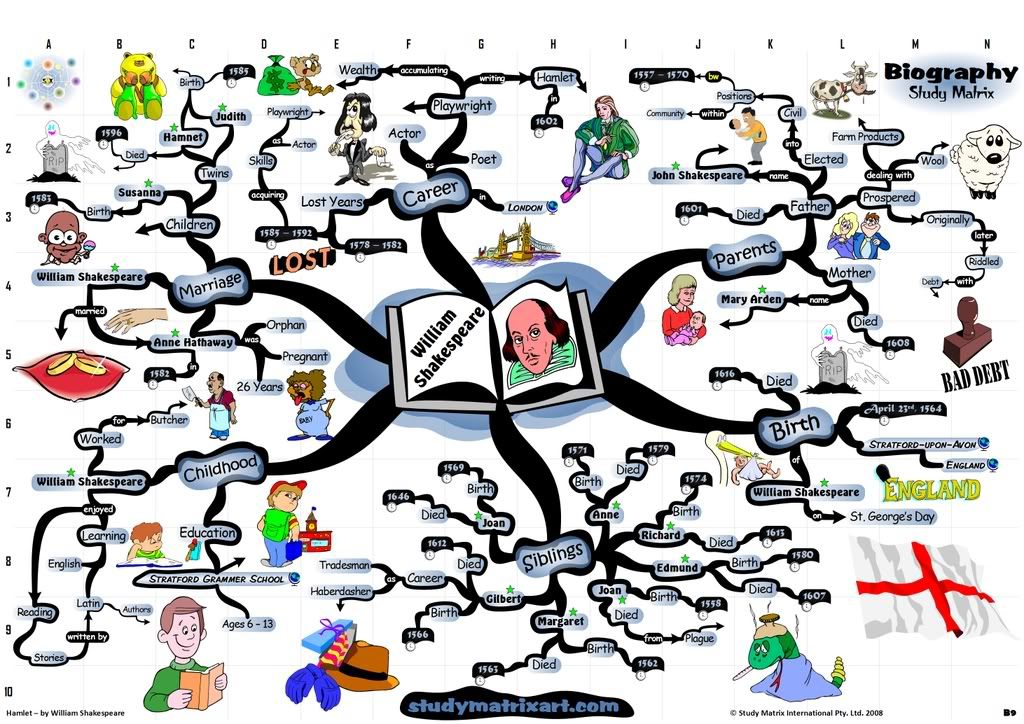
SHAKESPEARE DAY (23rd April)
On this day, England honours the death of William Shakespeare, one of the world's greatest dramatists and poets.

Click here to see the picture in a larger size.
[From As you like it]
Some really interesting links by the BBC on two of Shakespeare's plays:
Thou art more lovely and more temperate:
Rough winds do shake the darling buds of May,
And summer's lease hath all too short a date:
Sometime too hot the eye of heaven shines,
And often is his gold complexion dimm'd;
And every fair from fair sometime declines,
By chance or nature's changing course untrimm'd;
But thy eternal summer shall not fade
Nor lose possession of that fair thou owest;
Nor shall Death brag thou wander'st in his shade,
When in eternal lines to time thou growest:
So long as men can breathe or eyes can see,
So long lives this and this gives life to thee.
- http://www.bbc.co.uk/schools/gcsebitesize/english_literature/dramamerchantvenice/movplotact.shtml
- http://www.bbc.co.uk/schools/gcsebitesize/english_literature/dramaromeojuliet/romeocharact.shtml
SONNET 18
Shall I compare thee to a summer's day?Thou art more lovely and more temperate:
Rough winds do shake the darling buds of May,
And summer's lease hath all too short a date:
Sometime too hot the eye of heaven shines,
And often is his gold complexion dimm'd;
And every fair from fair sometime declines,
By chance or nature's changing course untrimm'd;
But thy eternal summer shall not fade
Nor lose possession of that fair thou owest;
Nor shall Death brag thou wander'st in his shade,
When in eternal lines to time thou growest:
So long as men can breathe or eyes can see,
So long lives this and this gives life to thee.
| SONNET 18 | PARAPHRASE | |
| Shall I compare thee to a summer's day? | Shall I compare you to a summer's day? | |
| Thou art more lovely and more temperate: | You are more lovely and more constant: | |
| Rough winds do shake the darling buds of May, | Rough winds shake the beloved buds of May | |
| And summer's lease hath all too short a date: | And summer is far too short: | |
| Sometime too hot the eye of heaven shines, | At times the sun is too hot, | |
| And often is his gold complexion dimm'd; | Or often goes behind the clouds; | |
| And every fair from fair sometime declines, | And everything beautiful sometime will lose its beauty, | |
| By chance or nature's changing course untrimm'd; | By misfortune or by nature's planned out course. | |
| But thy eternal summer shall not fade | But your youth shall not fade, | |
| Nor lose possession of that fair thou owest; | Nor will you lose the beauty that you possess; | |
| Nor shall Death brag thou wander'st in his shade, | Nor will death claim you for his own, | |
| When in eternal lines to time thou growest: | Because in my eternal verse you will live forever. | |
| So long as men can breathe or eyes can see, | So long as there are people on this earth, | |
| So long lives this and this gives life to thee. | So long will this poem live on, making you immortal. |
Learn more about Shakespeare's life and works with this online exercise:
SHAKESPEARE, by olgapalomar
Sunday, 30 September 2012
Friday, 6 April 2012


Sunday, 1 April 2012
OSCAR WILDE'S The importance of Being Earnest
Have a good laugh with Wilde's humour and fine irony. Read and listen to an extract from The Importance of Being Earnest.

(You'll find some exercises on the second page and the keys to check your answers!)
Click on the green arrow to download this worksheet.
And listen:
Subscribe to:
Posts (Atom)